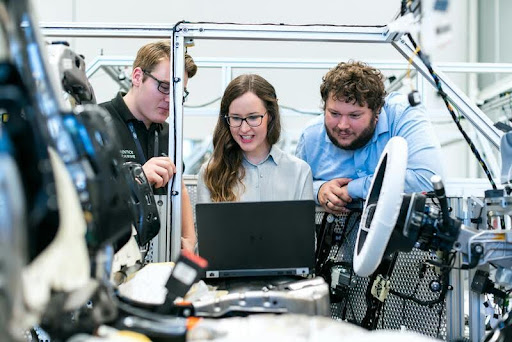
Hands-on learning in action—team members study vehicle parts in the workshop.
Introduction: Why should we even care about AI in cars?
It’s simple: AI is already changing the way we build, drive, and experience vehicles, and most of us don’t even realize it. You’ve probably heard buzz about “self-driving cars,” but it’s far more than that. From factories in Detroit to smart dashboards cruising down Route 66, AI is behind the scenes, quietly reshaping the ride. Ready to dive into five ways that’s happening? Let’s go, fasten your seatbelt.
1. How is AI speeding up car manufacturing?
Here’s the deal: car production used to be about repetitive tasks, humans tightening bolts, inspecting parts, then doing it all over again. Now? AI steps in and says, “Let me handle the boring stuff.” Machine vision systems detect flaws faster than any human eye, and predictive algorithms flag when a robot arm might malfunction. This means fewer production delays, better quality, and yes, faster assembly lines. Who doesn’t want their new ride sooner?
2. What role does AI play in vehicle safety systems?
Driving’s life-or-death work, so safety counts. AI powers systems that sense when you drift out of your lane, brake too late, or spot that kid chasing a ball. Those driver-assist and pre-crash systems use radar and cameras, guided by AI brains that react in milliseconds. Think of it as your third eye, always watching your back. Safer roads for everyone? That’s a win.
3. What’s the best way AI predicts vehicle maintenance?
Ever get that dreaded “Check Engine” light? AI is now the best mechanic whisperer. By constantly analyzing engine data, tire pressure, battery health, and more, AI predicts issues before they get serious. No more surprises at 2 a.m. on an interstate somewhere. Estimates show predictive maintenance powered by AI can reduce unexpected breakdowns by up to 30%. That’s U.S. drivers spending less time stuck on the side of the road, and more time where we belong: moving forward.
4. How does AI improve supply chain and logistics for cars?
Order parts, ship parts, assemble cars, deliver cars, it’s a chain with lots of links. AI helps forecast which parts will be needed and when, trims delivery routes, and even organizes stock in warehouses to cut downtime. For big American automakers dealing with millions of parts, this isn’t a nice-to-have; it’s a must-have. Quicker builds. Lower costs. Smoother operations coast to coast.
5. How is AI making the in-car experience smarter and more personal?
Ever say, “Play my road-trip playlist,” and have your car do it? That’s AI at work. Infotainment systems now understand your voice better, remember your favorite settings, seat position, cabin temperature, radio station, and adapt. They even suggest the fastest route home that avoids traffic. It’s like your car learns what you like and tries to make every ride just right. Feels personal because it is.
Wrapping up, why does all this matter to us
So, five ways US automotive is using AI: manufacturing, safety, maintenance, logistics, and personalization. Each one makes your life easier, whether you’re waiting in traffic, planning a road trip, or just firing up the ignition. AI isn’t sci-fi. It’s practical, helpful, and pretty much your ride’s best co-pilot.
Want to see these in action? Drop me a note, or share your own “Hey, my car did X” story, let’s talk about it!
FAQ (FAQ-Styled for Schema Markup)
Q: How is AI used in manufacturing cars? A: AI speeds up assembly through machine vision for defect detection and predictive maintenance on factory equipment.
Q: How does AI improve vehicle safety? A: It powers real-time hazard detection and driver-assist features that help prevent crashes.
Q: Can AI predict car problems? A: Yes, AI analyzes data from sensors to forecast issues early, reducing unexpected breakdowns significantly.
Q: How does AI optimize the automotive supply chain? A: By forecasting demand, improving inventory management, and streamlining logistics and delivery routes.
Q: What makes in-car AI experiences so smart? A: AI remembers preferences, understands voice commands, and adapts navigation and entertainment to your habits.
Final Thoughts
There you go, a friendly, down-to-earth look at how AI is changing cars in the U.S., from the factory floor to your dashboard. Written in a style that keeps you reading, with SEO-friendly headings, natural phrasing, and just the right amount of casual flair. If there’s one thing to remember: your ride’s smarter than you think, thanks to AI.
About the Author




