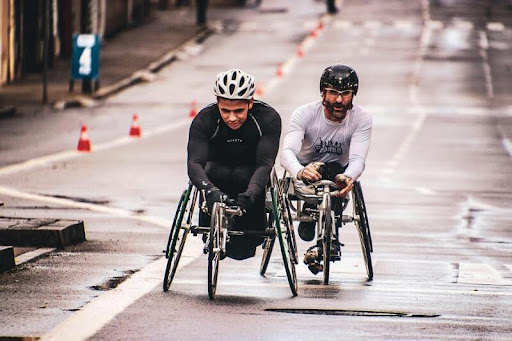
Adaptive cycling in action—breaking barriers and enjoying the ride.
Let’s dive right in. AI is quietly becoming a game-changer for people with disabilities, making daily life, school, work, and online spaces more welcoming. It’s not sci-fi. It’s here, and it’s real.
Why Should You Care About AI and Accessibility?
Because over 61 million U.S. adults, or about 1 in 4, report having a disability (CDC). That’s significant. And more than 1 in 4 adults now have some form of disability, up from 24.6% in 2016 to 28.7% in 2022 (GovTech). That means accessibility matters to a growing slice of the population. AI can bridge gaps if we do it well.
What Can AI Do to Make Tech More Accessible?
AI isn’t magic, but it’s powerful. It can add captions in real time, read webpages aloud, describe images, simplify content, and even help folks navigate their environment.
Think of it like this: AI tools are like digital accessibility helpers working behind the scenes, making websites, classrooms, and devices more user-friendly.
How Does AI Help in Education?
Schools are rolling out AI tools like chatbots and word-prediction programs that help students with disabilities, like dyslexia, keep pace with classmates (Schools are still learning to harness it”>AP News). One student said AI helped her make the honor roll when reading was a struggle.
Meanwhile, tools that transcribe speech in real time are leveling the playing field for deaf or hard-of-hearing students (Every Learner Everywhere). And smart writing aids? They’re going beyond spell check, helping with word choice and grammar. It’s like having an extra tutor without the price tag.
What About Real-Time Help for the Visually Impaired?
Ever heard of Be My Eyes? It used to pair blind users with live volunteers to describe what’s around them. Now it includes Be My AI, using GPT-4 to describe images, and people can ask follow-up questions (Wikipedia). That’s independence in action. Since launch, it has had over a million sessions in just a few weeks and was named one of Time’s best inventions of 2023 (Wikipedia).
Is AI Making Web Accessibility Better, or Worse?
Here’s the catch: AI tools like accessiBe promise instant accessibility fixes, but they’re not foolproof. They can mislabel images or misinterpret page layout, and blind users report issues like audio describing bullet points as toilets (Financial Times, WIRED). That led to thousands of digital accessibility lawsuits, especially in 2023 (Financial Times).
So yeah, AI helps, but humans still need to check the work.
You can’t just flip the switch and call it done.
How Is AI Improving Smart Devices and Workplaces?
AI is in your home, too. Apple’s latest iOS and iPadOS include eye-tracking for device control, better speech recognition, and haptic feedback, all using AI (Lifewire). Imagine controlling your phone with just your eyes; that’s a real boost for folks with mobility challenges.
On the job, Microsoft’s Copilot is saving disabled employees nearly 20 hours a month by offering real-time captions, filtering messages, and more (The Australian). A whopping 91% of disabled workers said it was a “valuable assistive technology” (The Australian). That’s huge.
Are There Biases or Risks We Should Watch For?
Yes. AI isn’t neutral. Studies show that hiring tools may downgrade resumes with disability-related achievements, and remote proctoring software can penalize students with disabilities for behaviors tied to their condition (San Francisco Chronicle). AI tools need inclusive design, or they can replicate real-world bias.
That’s why groups like the U.S. Access Board are evaluating risks and benefits of AI for the disability community (Access Board Presents Preliminary Findings on Artificial …”>access-board.gov).
Can AI Be More Inclusive, Not Exclusive?
Absolutely, but only if we build it right. AI should augment, not replace, human accessibility support (The American Foundation for the Blind). Plus, many datasets lack diversity, and disability representation in training data is weak (A Meta-Analysis”>arXiv). Without better data from diverse communities, AI can miss the mark.
What About Helping More People Access Assistive Tech?
The Assistive Technology Act brings federal funding to all U.S. states to help 50 million Americans get devices, from cash assistance to refurbished gadgets (Wikipedia). Combine that with AI, and we’ve got some real momentum to scale access.
Transitioning from Tool to Trust
So, where do we go from here?
- Use AI for what it’s good at: live captioning, image description, writing support.
- Don’t forget human oversight: AI isn’t perfect yet.
- Push for inclusive datasets: we need more voices behind the tech.
- Know your rights: ADA and new DOJ guidelines (especially in schools) mean accessibility isn’t optional (Schools are still learning to harness it”>AP News).
- Advocate for policy: state mandates are pushing accessible digital services by 2026 (GovTech).
FAQ (for Schema Markup)
Q: How is AI helping people with disabilities in the U.S.? A: AI powers tools like real-time transcription, image and scene descriptions, voice control, and writing aids to improve access.
Q: Are AI accessibility tools reliable? A: They help a lot, but they still make mistakes; human review and accessible design are essential.
Q: What percentage of Americans have a disability? A: About 1 in 4 U.S. adults, over 61 million people, report having a disability (CDC).
Q: Can AI help students with disabilities at school? A: Yes. Tools like chatbots, real-time transcription, and word-prediction enhance learning, although schools must ensure students still learn the skills themselves (AP News).
Q: How can developers make AI more inclusive? A: By involving diverse disability communities in design, using representative data, and testing tools with real users.
Final Thoughts, AI and Us, Together
So, is AI supporting accessibility? Heck yes, but it’s not a finish line. It’s part of an ongoing journey. AI helps students learn faster, helps employees stay on top of work, and connects visually impaired users with their world. It’s powerful, but imperfect.
We all have a role: as developers, educators, employers, policymakers, or just as curious citizens.
About the Author




