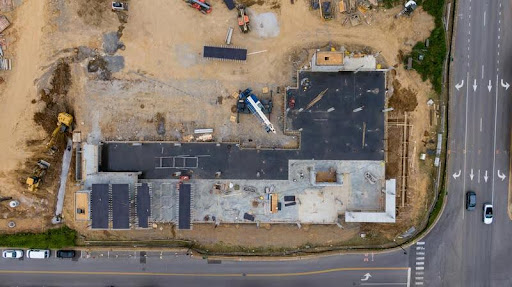
Progress from above: precision and planning shaping the future of modern construction near busy roads.
The construction industry is rapidly evolving. Tasks that once took weeks or months can now be completed in just days with the right technology. However, are you keeping pace? In today’s world, technology is no longer an optional perk; it’s a necessity. From design and planning to safety on-site and productivity, contemporary construction technology is revolutionizing how builders operate. Let’s explore the essential tools that every builder should be familiar with in 2025.
Why Is Technology Crucial in Modern Construction?
The role of technology in construction extends beyond flashy devices; it focuses on enhancing efficiency, precision, and safety. Projects are larger, timelines are tighter, and client expectations are soaring. Utilizing the appropriate tools can help prevent errors, cut costs, and expedite project completion. But here’s the critical question: if you’re not leveraging contemporary technology, how competitive are you likely to be in 2025?
What Is the Most Effective Project Management Software for Builders?
Project management software can be transformative. It consolidates everything in one location, from schedules to tasks to team communication. Consider it the nerve center of your project.
With this software, you can:
Monitor deadlines and milestones in real-time.
Delegate tasks and instantly check progress.
Minimize miscommunication across teams.
Look for key features such as cloud access, mobile support, and integration with other construction tools. The objective is clear: simplify the management of intricate projects so you can direct your attention to the construction itself.
How Does Building Information Modeling (BIM) Enhance Construction Projects?
BIM tools are beneficial not only for architects but for everyone involved in the project. BIM enables you to develop comprehensive 3D models of your project before laying a single brick.
Advantages include:
Identifying design issues before construction begins.
Enhancing team collaboration by sharing a unified digital model.
Minimizing mistakes and expensive rework on the job site.
With BIM, all parties are aware of the current status, reducing the likelihood of unexpected challenges. It’s akin to having a virtual tour of your project at any given time.
Why Are Drones Becoming Vital on Construction Sites?
Drones are not merely novelty items, they are essential tools that enhance safety and save time. From site surveys to inspections, drones provide an aerial perspective of your location in mere minutes.
Benefits include:
Rapidly surveying vast areas without exposing teams to hazards.
Obtaining high-resolution images and videos for tracking progress.
Spotting potential safety risks before they escalate.
Using drones allows you to oversee every aspect of your project, ensuring everything remains on schedule and secure.
How Are 3D Printing and Prefabrication Transforming Construction?
3D printing has progressed beyond prototypes; it’s now influencing the construction of structures.
Prefabrication also decreases on-site workforce needs and accelerates construction timelines. Here’s why builders are taking notice:
Components are manufactured with accuracy off-site and assembled swiftly at the location.
Reduced waste and fewer mistakes translate to decreased expenses.
Executing intricate designs becomes simpler.
In brief, these technologies enhance construction speed, cleanliness, and accuracy. Picture trimming weeks off a schedule simply by employing smarter techniques for producing building components.
How Can Augmented Reality (AR) and Virtual Reality (VR) Assist Builders?
AR and VR aren’t just trendy technology; they elevate planning, training, and teamwork.
Practical applications include:
AR can project digital plans onto physical sites for enhanced visualization.
VR enables virtual inspections of the project before construction.
Teams can undergo training safely in simulated environments.
These technologies mitigate misunderstandings, enhance design precision, and enable workers to comprehend complex projects more rapidly.
What Wearable Technology and Safety Devices Should Every Worker Utilize?
Worker safety remains a top priority, and wearable technology is enhancing that aspect. Smart helmets, sensors, and tracking tools monitor personnel and avert mishaps.
Benefits include:
Timely alerts for hazardous situations.
Monitoring fatigue or exposure to dangerous substances.
Guaranteeing adherence to safety regulations.
It’s akin to having a safety supervisor accompanying you at all times, only more intelligent and efficient.
How Do IoT Devices Enhance Construction Site Efficiency?
The Internet of Things (IoT) isn’t limited to smart homes; it extends to intelligent construction. Sensors and connected technologies track equipment, materials, and conditions in real-time.
Benefits include:
Predictive maintenance minimizes downtime.
Resource tracking ensures nothing is misplaced or improperly utilized.
Data-driven insights facilitate workflow optimization.
IoT provides a comprehensive perspective on your site’s operations, simplifying planning and rapid response.
Why Are Mobile Apps Essential for On-Site Productivity?
Smartphones are not just for emails; they are potent instruments for construction. Mobile applications enable teams to document issues, monitor progress, and access files directly on-site.
Key advantages include:
Immediate communication between field and office personnel.
Seamless access to blueprints, permits, and timelines.
Quicker decision-making and issue resolution.
A well-designed app transforms your phone into a mobile command center, ideal for bustling job sites where every second matters.
How Do You Select the Appropriate Tools for Your Projects?
Selecting the right construction technology is not about acquiring everything available; it’s about choosing tools that correspond to your requirements. Begin by identifying challenges: Are delays impacting your finances?
Miscommunications causing errors? Safety incidents slowing progress? Then find the tech that solves those specific issues.
Keep it practical, scalable, and easy to adopt. Sometimes the simplest tools have the biggest impact.
The Bottom Line on Construction Tech in 2025
2025 is shaping up to be a tech-driven year for construction. The right tools make projects faster, safer, and more accurate. Builders who adopt modern software, drones, BIM, wearable tech, and mobile apps will have a clear advantage.
Technology isn’t a gimmick; it’s a strategic choice that keeps your projects running smoothly and your teams working smarter, not harder.
FAQ: Construction Tech Tools 2025
Q: What is the most important construction tech tool in 2025? A: While all tools are useful, project management software and BIM are critical for organization and accuracy.
Q: How do drones help in construction? A: They provide quick site surveys, progress monitoring, and safety inspections, reducing manual labor and risk.
Q: Are wearable devices really necessary on construction sites? A: Yes. They improve worker safety, monitor conditions in real time, and help prevent accidents.
Q: Can 3D printing really save time in construction? A: Absolutely. It allows precise off-site fabrication, reducing on-site labor and speeding up project timelines.
Q: How do mobile apps improve on-site productivity? A: They streamline communication, provide instant access to plans and schedules, and make problem-solving faster.
About the Author




