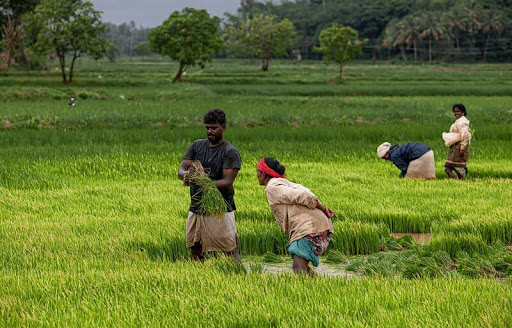
Hands in the soil, eyes on the harvest—farming meets nature’s rhythm.
Technology is revolutionizing our food production methods, with artificial intelligence (AI) playing a crucial role in this evolution. Traditionally, farming has focused on engaging with nature, but it now also involves harnessing data, automation, and intelligent decision-making tools.
As the U.S. population is projected to reach approximately 370 million by 2050, the challenge of adequately feeding everyone intensifies. The need to cultivate more, minimize waste, and safeguard our land and water resources is greater than ever. AI’s role in agriculture isn’t a concept of the future; it is actively transforming the operations of American farms today. The most encouraging aspect? It is enhancing farming practices to be smarter, rather than merely larger.
Why Is AI Essential for U.S. Agriculture at This Moment?
In reality, modern farming represents a delicate balancing act. Farmers must meet the food demands of a growing population while contending with unpredictable weather patterns, declining rural labor forces, and increasing costs for essentials such as fuel and fertilizer. When you factor in environmental challenges like soil depletion and water shortages, it becomes evident that innovation is crucial.
According to the U.S. Department of Agriculture (USDA), farm productivity will need to increase by about 70% over the next 25 years to meet demand. Achieving this significant increase cannot rely solely on traditional farming practices. AI provides a solution to optimize each acre, leveraging data-driven insights for more efficient and sustainable operations.
What Is AI in Agriculture, Specifically?
When discussing AI in agriculture, we refer to computer systems capable of learning from data, recognizing patterns, and making decisions, often with more speed and accuracy than humans.
In the agricultural sector, AI can be used to:
Assess soil and weather information.
Forecast crop yields.
Identify pests or diseases at early stages.
Automate repetitive activities such as planting, irrigating, and harvesting.
AI is not meant to replace farmers; instead, it aims to equip them with the “superpowers” that result from having immediate access to precise and actionable information.
How Is AI Currently Implemented in Farming?
AI’s application in agriculture encompasses various tools, functioning as an integrated suite of resources. Below are some of the most significant ways it is utilized across U.S. farms.
1. Precision Farming: In What Ways Can AI Support Farmers in Resource Management?
Precision farming focuses on delivering the appropriate quantity of water, fertilizer, and other resources at just the right moment, no excess or deficiency.
AI technologies can analyze satellite images, soil sensors, and weather data to accurately determine where interventions are necessary. This strategy minimizes waste, cuts expenses, and aids in environmental preservation. For instance, instead of irrigating an entire field, farmers can leverage AI insights to target only the sections that require watering the most. This leads to improved crop health and less pressure on water resources.
2. Predictive Analytics: Is AI Capable of Anticipating Agricultural Success?
Absolutely, and with impressive precision. AI forecasting models can evaluate years of agricultural and climatic data to predict yields, pinpoint potential challenges, and even suggest optimal planting times.
Consider being aware in advance of how a growing season may unfold. Farmers can use this knowledge for labor planning, managing supply agreements, and modifying their crop selections to meet market needs. In a nation where farming serves as both a source of income and a business, such insight is transformative.
3. Automated Farming Systems: What Functions Can AI-Powered Equipment Perform?
AI is driving automated technologies that can sow seeds, harvest crops, and sort produce without the need for constant human intervention. These machines can operate for extended periods and under conditions that might hinder human teams.
This approach not only saves time but also addresses the increasing labor scarcity in agriculture. By managing repetitive tasks, AI allows farmers and laborers to concentrate on more skilled, decision-making responsibilities.
4. Pest and Disease Detection: How Does AI Safeguard Crops?
Crops can deteriorate from healthy to struggling within days if pests or diseases are present. AI image-recognition technologies can examine plants and identify early indicators, sometimes even before they are visible to the naked eye.
By detecting issues early, farmers can treat only the impacted areas instead of applying chemicals across the entire field. This leads to reduced chemical usage, lower expenses, and healthier produce.
What Are the Advantages of AI in U.S. Agriculture?
The perks of AI in farming accumulate rapidly:
Increased Yields: AI enables farmers to produce more food on the same acreage by optimizing every production phase.
Reduced Waste: Resources such as water, fertilizer, and energy are utilized more effectively.
Improved Quality: Early problem detection results in healthier, more uniform crops.
Cost Savings: Intelligent systems lower labor and resource expenses over time.
Sustainability: AI promotes agricultural practices that are more environmentally friendly.
Together, these advantages not only benefit individual farms but also enhance the entire agricultural supply chain in the U.S.
What Obstacles Are Associated with AI in Agriculture?
As with any significant transition, the implementation of AI in farming presents certain challenges.
High Initial Costs: Establishing AI solutions, sensors, and advanced machinery necessitates a considerable investment.
Training Requirements: Agricultural producers and laborers must acquire skills in utilizing and maintaining new technologies.
Data Security Issues: Essential farm information, such as soil conditions or crop yields, must be securely stored and safeguarded.
Connectivity Challenges: Remote regions may face difficulties achieving the internet speeds required for real-time AI functionality.
Addressing these issues will necessitate cooperation among farmers, technology creators, and lawmakers.
What Lies Ahead for AI in U.S. Agriculture?
AI applications in farming are currently developing, but the possibilities are vast. In the next few years, we can anticipate:
Enhanced Climate Adaptation: AI tools that assist farmers in adapting to shifting weather patterns and severe conditions.
Completely Automated Farms: Increased mechanization in seeding, irrigation, and harvesting processes.
Collaborative Food Networks: AI connecting farms with supply chains to minimize waste and enhance distribution.
As climate change and growing populations exert pressure on the food system, AI is likely to become as vital to agriculture as tractors and irrigation systems are today.
Final Thoughts: The Importance of AI for Agriculture’s Future
Feeding the future population of the United States involves more than just increasing acreage; it requires smarter planting practices. AI provides farmers with the knowledge and resources necessary to enhance food production while conserving resources and protecting the environment.
From forecasting future yields and identifying pest issues early to automating labor-intensive tasks, AI is transforming agriculture into a more resilient, efficient, and sustainable food supply chain.
The farms of the future won’t merely cultivate crops; they will also cultivate data. And that’s a harvest that deserves investment.
FAQ: AI in Agriculture
Q1: What does AI in agriculture entail? AI in agriculture employs computer systems to assess data, automate operations, and enhance farming decision-making.
Q2: In what ways does AI assist farmers in conserving resources? AI evaluates soil, climatic, and crop information to apply water, fertilizers, and pesticides precisely where it is needed, minimizing waste.
Q3: Is AI taking over the role of farmers? No. AI is designed to assist farmers with repetitive or data-intensive tasks, freeing them to concentrate on strategic choices.
Q4: What are the primary obstacles to implementing AI in farming? Significant hurdles include high expenses, the need for training, concerns over data privacy, and internet connectivity issues in rural areas.
Q5: Will AI be essential for the farming of the future?
About the Author