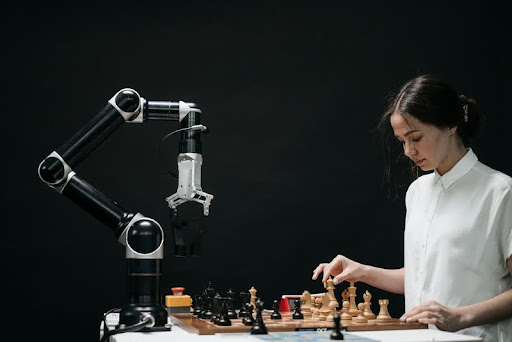
Man vs. machine? A quiet game of chess explores the evolving relationship between humans and AI.
You’ve probably heard people tossing around terms like AI, machine learning, and maybe even deep learning. They’re everywhere, on the news, in your favorite apps, and in conversations about the future of work. But what do they mean? And more importantly, how are they different?
Let’s break it down in plain English. No jargon, no confusion, just clear answers to the big question: What’s the difference between AI and machine learning?
What is Artificial Intelligence (AI)?
Artificial intelligence (AI) is a broad field of computer science focused on building systems that can perform tasks that typically require human intelligence. That includes things like reasoning, learning, problem-solving, and even understanding language.
At its core, AI is about mimicking the way humans think and act. It’s less about the specific tools used and more about the outcome, getting a machine to do something “smart.”
There are generally two types of AI:
- Narrow AI: This is what we have today. It’s designed to handle a specific task, like voice recognition or playing chess.
- General AI: This doesn’t exist yet. It refers to machines that can think, learn, and reason like a human across a wide range of tasks.
So when someone says “AI,” they’re usually talking about software that seems intelligent, even if it’s just good at recognizing patterns or following rules.
What is Machine Learning, and how does it work?
Here’s where the confusion usually starts.
Machine learning (ML) is a subset of AI. Think of it as a specific method used to achieve artificial intelligence. Instead of writing detailed rules for every situation, we give the machine data, and it learns from that data.
In simple terms, machine learning is about training a computer to find patterns and make decisions based on them. The more data it has, the better it gets. It’s kind of like how people learn from experience.
There are different types of machine learning, but the three main categories are:
- Supervised learning: The model learns from labeled data (we tell it what the right answers are).
- Unsupervised learning: The model finds patterns in unlabeled data all on its own.
- Reinforcement learning: The model learns through trial and error, getting “rewards” for good decisions.
So while AI is the goal, machine learning is one of the main ways we get there.
How are AI and Machine Learning different?
Let’s get straight to it.
| Aspect | AI | Machine Learning |
| Definition | The broader concept of machines acting smart | A subset of AI that learns from data |
| Goal | Simulate human intelligence | Find patterns and make predictions |
| Data dependency | May or may not rely heavily on data | Strongly dependent on large amounts of data |
| Flexibility | Can include rule-based systems | Requires training with data |
| Scope | Encompasses many techniques (including ML) | Focused specifically on learning algorithms |
AI is the big umbrella. Machine learning is just one piece of what fits under it.
How do AI and Machine Learning work together?
Think of AI as the dream, and machine learning as the tool helping us reach it.
Many of the smartest systems out there today use machine learning to power AI-based tasks. For example, instead of manually programming every response a chatbot should give, we let it learn from thousands (or millions) of past conversations.
ML provides the “brain,” helping AI improve on its own by learning from data. Without machine learning, AI wouldn’t be nearly as impressive or useful.
Is deep learning the same as machine learning?
Not quite, but close.
Deep learning is another subset of machine learning, inspired by how the human brain works. It uses complex neural networks (layers of interconnected “nodes”) to process huge amounts of data.
So in this tech family tree:
- AI is the big parent.
- Machine learning is the child.
- Deep learning is the grandchild.
Each level is more specialized, but they’re all working toward the same goal, making machines smarter.
Why do people mix up AI and ML so often?
Because in most day-to-day conversations, people use them interchangeably, and honestly, that’s okay sometimes.
Here’s the deal: Most of the AI systems we talk about today are powered by machine learning. So when someone says “AI is doing X,” what they mean is that “a machine learning model is doing X as part of an AI system.”
It’s kind of like saying your car drives itself. Technically, the car’s software and sensors are doing the work, but calling it “self-driving” still makes sense.
That said, if you’re diving into tech, business strategy, or data science, knowing the difference matters.
What are some common myths about AI and machine learning?
Let’s clear up a few misunderstandings:
1. AI and ML are the same thing.
Nope. ML is one way to build AI, but AI is the bigger picture.
2. AI is always learning.
Not true. Some AI systems are rule-based and don’t learn at all, they just follow programmed logic.
3. Machine learning is always better.
Not necessarily. ML is powerful but not always the best tool, especially for small data sets or well-defined rules.
4. AI means robots or human-like machines.
Not. Most AI today lives inside software, not humanoid robots.
Why does this difference matter for everyday people?
Whether you’re a student, a business owner, or just a curious reader, understanding the difference between AI and ML helps you better navigate the digital world.
It shapes how you interpret tech news, evaluate tools for your job, or even talk to your smart speaker at home. Plus, as AI and ML continue to grow, they’ll shape industries, influence policy, and create new job opportunities. The better we understand them, the better prepared we are.
According to a 2024 report by PwC, AI could contribute up to .7 trillion to the global economy by 2030, and much of that will come from machine learning-driven tools and platforms.
That’s not a future to ignore.
Want to dig deeper?
If you’re interested in exploring further, try looking into topics like:
- How machine learning algorithms are trained
- The ethics of AI in decision-making
- How companies are using AI and ML in hiring, healthcare, and finance
Or just keep an eye out. You’ll start to spot where these technologies are quietly shaping your everyday experiences.
FAQ: Quick Answers to Common Questions
Here’s a quick rundown of questions people often ask about this topic:
What is the main difference between AI and machine learning?
AI is the broader goal of creating smart machines. Machine learning is a technique used to achieve that goal by training systems on data.
Can you have AI without machine learning?
Yes. Some AI systems use rule-based logic instead of learning from data. But most modern AI does use machine learning.
Is machine learning better than AI?
Not better, just more specific. ML is a subset of AI, so it depends on the use case.
What’s an easy way to remember the difference?
Think of AI as the destination and machine learning as one of the main roads leading there.
Final thoughts
So, AI vs. machine learning, what’s the verdict?
They’re related, but not the same. AI is the big-picture idea of machines acting smart. Machine learning is one of the key ways we make that happen by letting computers learn from data.
Understanding the difference doesn’t just make you sound smarter (though it does), it helps you keep up in a world where tech is moving fast.
Curious to see how AI is already shaping your everyday life? Check out our upcoming posts where we explore exactly that.
Enjoyed this breakdown? Share it with a friend who’s still mixing up AI and ML, or drop a comment below with your biggest AI question. Let’s keep the conversation going.
Let me know if you’d like this adapted for another format, like a LinkedIn post, infographic, or email newsletter!
About the Author




