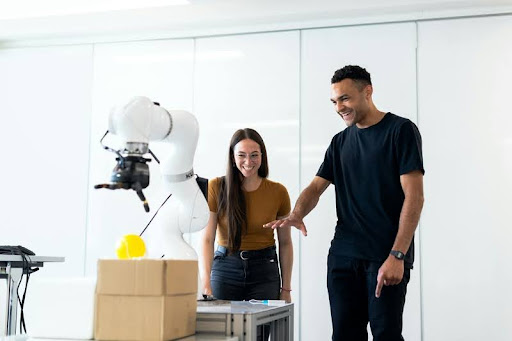
Collaboration meets innovation—designing the future of work, one robotic arm at a time.
Artificial Intelligence isn’t some far-off, sci-fi concept anymore. It’s already woven into your daily life, from the voice on your phone that gives you directions to the recommendations popping up on your favorite streaming platform. But here’s the big question: How is AI changing the way we work in the U.S.?
Whether you’re clocking in at an office, working from home, running a business, or looking to switch careers, AI is playing a bigger role than ever. Some people are excited. Others? A little nervous. Let’s break it all down and talk about what’s happening, and what it means for your job, your skills, and your future.
What is AI in the workplace, really?
In simple terms, Artificial Intelligence (AI) refers to computer systems that can perform tasks that normally require human intelligence. That might include learning from data, recognizing patterns, making decisions, or even “understanding” language.
In the workplace, AI shows up in different ways. You might not notice it, but it could be sorting resumes before a hiring manager ever sees them. It could be analyzing customer data to help sales teams or predicting maintenance needs on factory equipment.
It’s important to note: AI isn’t the same as automation. Automation handles repetitive tasks using fixed rules (think: auto-filling forms). AI goes a step further; it can adapt and improve over time. That’s why it’s such a game-changer.
How is AI changing the job landscape in America?
Let’s address the elephant in the room: Is AI taking over jobs?
Yes, and no.
AI is certainly reshaping jobs, but that doesn’t always mean replacing people. In many cases, AI is changing how we work rather than if we work. For example, instead of spending hours manually sorting through spreadsheets, a worker might use AI tools to do the heavy lifting, freeing them up for more creative, strategic, or interpersonal work.
Here’s the twist: Some jobs are disappearing, but others are being created or transformed. Roles involving data analysis, machine learning, and digital transformation are booming. Meanwhile, even traditional jobs, like those in retail, logistics, or healthcare, are evolving to include AI tools in daily workflows.
What skills will be most important in the era of AI?
This is a prevalent inquiry people often ask: What essential skills are required to work with AI?
The response? A combination of technological proficiency and traditional interpersonal abilities.
Tech skills that are in demand:
Basic understanding of data
Familiarity with AI tools and software
Programming (for higher-level positions)
Digital communication platforms
Soft skills that AI cannot replicate:
Analytical thinking
Emotional awareness
Innovativeness
Flexibility
An increasing number of organizations are devoting resources to reskilling and upskilling initiatives to support employees in adapting. So even if you don’t consider yourself a “tech person,” you can still excel in an AI-driven environment, especially if you are open to learning.
How is AI altering workplace culture and teamwork?
AI is not only transforming our tasks, it’s also changing the methods we employ to accomplish them.
For example, AI accelerates decision-making processes. Equipped with the right information, AI systems can detect patterns or potential issues more swiftly than a human team could. This enhances productivity but can also impose pressure to act quickly, which some employees may find stressful.
AI is also altering the way teams work together. Consider real-time language translation, auto-generated summaries of meetings, or intelligent project management assistants that help keep everyone organized. These innovations can enhance efficiency, but they also pose concerns regarding privacy, monitoring, and work-life balance.
Thus, while the workplace may be becoming more intelligent, employers must maintain the human aspect. Trust, adaptability, and compassion continue to be crucial.
What are the primary advantages and challenges AI presents for employees?
Let’s examine the benefits and drawbacks.
Advantages:
Increased flexibility. AI can handle repetitive tasks, allowing individuals to concentrate on more valuable responsibilities or creative endeavors.
Enhanced decision-making. AI tools assist in quickly highlighting insights, facilitating more informed strategies.
Emergent career opportunities. AI is creating positions that didn’t exist a decade ago, especially in the fields of data, ethics, and technology.
Drawbacks:
Job loss. Certain positions are diminishing or vanishing completely, particularly in manufacturing and administrative fields.
Expanding skill gaps. Employees lacking access to training may find themselves at a disadvantage.
Bias and transparency. AI technologies can mirror human biases if not thoughtfully designed and supervised.
Additionally, the emotional impact should not be overlooked. Ongoing changes and uncertainties can be draining. That’s why support for mental health and job assistance services is becoming even more critical.
What actions should U.S. employers take to adapt to AI?
AI is not solely an issue for IT; it’s also a concern for business and people.
Here’s what companies should be doing:
- Rethinking job design. Combining human strengths with AI capabilities creates more dynamic roles.
- Updating hiring processes. Prioritize adaptability, not just technical expertise.
- Supporting lifelong learning. Provide opportunities for employees to reskill without fear.
- Being transparent. Workers deserve to know when AI is involved in decisions that affect them, like hiring or performance reviews.
Bottom line? The companies that succeed will be the ones that see AI as a collaborator, not a replacement.
What does the future of work in America look like with AI?
The truth is, we’re still figuring it out. But some trends are becoming clear.
- Work will be more digital. Even traditionally “offline” industries are embracing AI.
- Careers will be less linear. People may switch roles or industries more often as technology evolves.
- Education will shift. Instead of one degree for life, many Americans will seek ongoing certifications or microcredentials.
- People will need to stay curious and flexible. That may be the most valuable skill of all.
So if you’re asking yourself, “How can I future-proof my career?”, you’re already ahead of the game. The key is to stay informed, be open to learning, and don’t be afraid to adapt.
FAQ: How AI Is Changing Work in America
What types of jobs are most at risk due to AI? Jobs that involve repetitive, rule-based tasks, like data entry or basic customer service, are more likely to be automated.
Will AI create more jobs than it eliminates? Possibly. While some jobs will disappear, others will be created in AI development, maintenance, ethics, and support roles.
How can workers prepare for AI in the workplace? Learn basic digital skills, stay flexible, and explore training programs. Even small tech improvements to your current role can make a big difference.
Can AI replace creative jobs? Not entirely. AI can assist with content creation or brainstorming, but human creativity, emotion, and nuance are still essential.
Is AI being used in hiring decisions? Yes, many employers use AI to screen resumes or assess candidate fit. Transparency and fairness are major concerns in this area.
Final Thoughts: Stay Human in an AI World
AI is here, and it’s not slowing down. But that doesn’t mean we’re being replaced. Far from it.
The real story is about humans and machines working together, not in competition, but in collaboration. It’s about using AI to do what it does best, so people can focus on what they do best.
If you’re curious, adaptable, and ready to keep learning, you’re in a good spot. Whether you’re a student planning your future, a professional eyeing your next move, or a business owner navigating change, AI isn’t the end of work.
About the Author




