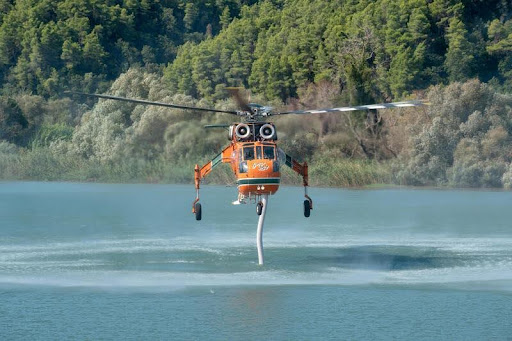
A firefighting helicopter in action, skimming a Greek river to refill water tanks and battle nearby wildfires.
Every advantage counts when seconds count. In the United States, emergency response systems are the foundation of public safety, but they are also extremely complicated. When lives are at stake, you may ask yourself how technology, particularly artificial intelligence, can truly make a difference. The short answer is that artificial intelligence (AI) is revolutionizing the detection, management, and resolution of emergencies by enabling quicker, more intelligent, and more effective responses.
Let’s examine the specifics of how AI is enhancing emergency response systems nationwide and why this is important for everyone, including regular citizens and first responders.
What Part Does AI Play in Analyzing Data for Emergency Response?
When it comes to processing large volumes of data quickly, AI excels.
Consider the massive amounts of data that emergency systems receive every second, including weather reports, social media alerts, sensor readings, 911 calls, and more. No human being can process that amount of information quickly enough.
AI swiftly examines this data to identify trends and indicators that might point to an emergency or assist in forecasting where one might occur next. For example, it can detect anomalous sensor activity that indicates fires or accidents, or it can identify groups of distress calls from a specific area.
Based on real-time insights, emergency teams are able to make decisions more quickly thanks to this clever data crunching. Their response time is greatly accelerated since they receive targeted, pertinent information that directs them to the issue rather than having to sift through endless reports.
How Can AI Help with Emergency Dispatch and Communication?
Getting the right help to the right place quickly is one of the largest bottlenecks in emergency response. This frequently depends on how resources are allocated and calls are handled.
This is where systems driven by AI come into play. By automating the triage process, they can rapidly determine which emergencies require immediate attention. To appropriately prioritize a 911 call, for instance, AI algorithms can examine the voice and tone of the call as well as the keywords used.
The AI-powered dispatch system can then assign responders according to their location, skill set, and real-time availability.
This guarantees that resources aren’t wasted or duplicated and prevents delays or confusion.
By instantly sharing pertinent information, AI also helps emergency teams, police, firefighters, and paramedics coordinate better and stay in sync. Time and lives are saved as a result of quicker, more effective responses.
How Does AI Aid in Situational Awareness and Real-Time Monitoring?
Being aware of the situation in real time is essential during an emergency. AI assists by analyzing data streams that are simply too big for humans to handle on their own, such as live video feeds, sensors, drones, and other sources.
AI can, for instance, instantly notify responders of possible fires or accidents by scanning camera footage for movement or smoke. In order to provide early warnings before disasters occur, sensors on buildings, bridges, and roadways can identify structural risks or hazards.
Emergency personnel can modify their strategy as necessary because of this constant monitoring, which provides them with minute-by-minute information about what’s happening. It helps responders stay ahead of the game, much like having a high-tech eye everywhere.
Which AI Applications of Predictive Analytics Are Most Effective for Emergency Preparedness?
The secret to effectively handling emergencies is to plan. AI is particularly good at predictive analytics, which is essentially predicting potential problem locations and times based on historical data.
AI models are able to forecast emergency hotspots by examining trends such as weather patterns, traffic data, and past incidents. By doing this, agencies are better able to plan, allocate resources where they are most likely to be needed, and avert crises before they arise.
For instance, emergency teams can get ready if data indicates that during a storm season, there is a higher risk of flooding in particular areas.
Predictive AI contributes to the development of strategies that increase community safety rather than merely responding to crises.
What Difficulties Arise When AI Is Used in Emergency Response?
AI isn’t a panacea, of course. There are significant obstacles to overcome.
The most important thing is data privacy. AI must adhere to privacy regulations and maintain data security because emergency systems handle sensitive personal information.
Another issue is bias in AI. Missed calls or unfair prioritization may result from faulty or unbalanced data used to train AI systems. Transparency and ongoing assessment are therefore essential.
It can also be challenging to integrate AI with the current emergency infrastructure. Many agencies use outdated systems that might not work well with modern technology, necessitating careful preparation and training.
Notwithstanding these challenges, continued research and cooperation between IT specialists and emergency personnel continue to enhance AI’s dependability and efficacy.
How Will AI Affect Emergency Response in the Future?
AI’s contribution to emergency response will only increase in the future. Even quicker detection, improved coordination, and more intelligent resource management are anticipated with developments in robotics, machine learning, and natural language processing.
Imagine chatbots taking care of non-urgent emergency calls to free up human operators, or AI-powered drones offering real-time aerial views.
Making sure responders have the resources and training they need to collaborate with AI will be crucial, as will striking a balance between innovation and moral application.
Why Is Artificial Intelligence Important for Emergency Response?
Regardless of whether you reside in a large city or a small town. A.I. in emergency response has an impact on you. In the event of a disaster, quicker and more intelligent emergency services translate into increased survival rates and reduced damage.
It is a potent illustration of how technology can benefit people by strengthening and enhancing public safety systems.
Frequently Asked Questions (FAQ)
Q1: What is the impact of AI on emergency response times? AI reduces delays by prioritizing calls, processing massive volumes of data instantly, and assisting in the prompt dispatch of the closest and most qualified responders.
Q2: Is artificial intelligence safe and secure in emergency systems? Yes, but in order to guarantee security and reliability, organizations must implement stringent data privacy regulations and constantly check AI for accuracy and fairness.
Q3: Is it possible for AI to anticipate emergencies before they occur? AI forecasts emergency locations using both historical and current data, which helps agencies prepare resources ahead of time.
Q4: Will AI take the place of human emergency personnel? No. AI is meant to help responders do their jobs more efficiently and effectively, not to replace them.
About the Author




