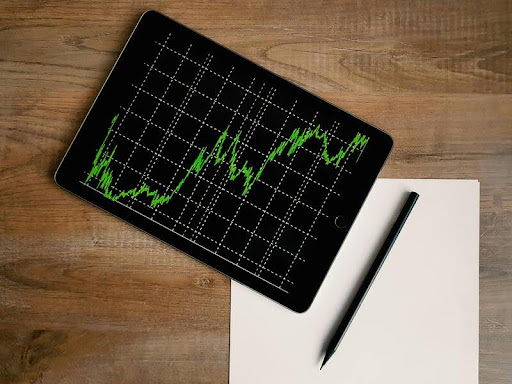
Tracking trends on the go—stock charts make market moves easier to follow, even from your tablet.
Let’s face it, stock market charts can look like a bunch of lines, bars, and numbers at first glance. Confusing? Absolutely. But once you learn how to read them, they become powerful tools that can help you make smarter investing decisions.
In this guide, we’ll break it all down for you, without the jargon or intimidating finance talk. Whether you’re just starting out or looking to sharpen your chart-reading game, you’ll walk away knowing how to read stock charts with more confidence (and way less guesswork).
What Is a Stock Market Chart and Why Should You Care?
A stock market chart shows how a stock’s price moves over time. That’s it.
It’s basically a visual timeline that investors use to spot trends, understand market behavior, and decide when to buy or sell. Think of it like a map; it won’t tell you exactly where to go, but it gives you a clear view of the road.
So, if you’ve ever wondered, “How do I know when to invest or sell?”, stock charts are part of the answer.
What Are the Different Types of Stock Market Charts?
1. Line Chart
This is the simplest chart out there. It tracks the closing price of a stock over time and draws a line connecting those dots. Super clean and easy to follow.
Best for: Getting a quick view of the overall trend.
2. Bar Chart (OHLC)
Bar charts show four key prices for a specific time period: Open, High, Low, and Close (OHLC). Each bar gives you a fuller picture of price movement in that time frame.
Best for: Seeing price volatility and daily performance.
3. Candlestick Chart
The candlestick chart is a favorite among many traders. It shows the same OHLC data but in a more visual way, with “candles” that are color-coded. Typically, green means the price went up, and red means it went down.
Best for: Spotting short-term patterns and signals.
What Should You Look for on a Stock Chart?
When you open a stock chart, it might look busy. But don’t worry, here are the core elements to focus on:
- Timeframe: Charts can show data by the minute, day, week, or year. Zoom in for short-term moves or zoom out to see the big picture.
- Price Axis: Usually runs along the right-hand side. It shows the stock’s value over time.
- Volume Bars: These sit below the chart and show how many shares are being traded. Higher volume = more interest.
- Support and Resistance Lines: These are key levels where the stock price tends to bounce (support) or get stuck (resistance).
What Are the Most Common Stock Chart Patterns?
If you’ve heard people talk about “reading patterns” on charts, they’re referring to price behavior that tends to repeat. These patterns help traders guess what might happen next. Here are the big ones:
Uptrend
Prices are moving higher over time. Looks like a staircase going up.
Downtrend
Prices are dropping steadily. Think of a slide at the playground.
Consolidation
Price moves sideways in a tight range. This means indecision, buyers and sellers are kind of in a standoff.
Breakout
When the price suddenly moves beyond a support or resistance level. It often signals the start of a new trend.
Reversal
When an uptrend flips into a downtrend, or vice versa.
You don’t need to memorize every pattern out there. Just start noticing these movements and how they play out over time.
Which Technical Indicators Should Beginners Learn First?
Technical indicators are tools that help you understand what’s happening beneath the price chart. They’re like little cheat codes for deeper insights.
Here are the top beginner-friendly ones:
Moving Averages (MA)
This smooths out price action by showing the average stock price over a certain number of days. The Simple Moving Average (SMA) and Exponential Moving Average (EMA) are the most popular.
Why it matters: Helps you spot trends and potential turning points.
Relative Strength Index (RSI)
This shows whether a stock is overbought (too expensive) or oversold (too cheap) on a scale from 0 to 100.
Why it matters: An RSI above 70 might mean a pullback is coming; below 30 could mean it’s due for a bounce.
MACD (Moving Average Convergence Divergence)
Sounds complicated, but it’s basically two moving averages that help you identify momentum and trend direction.
Why it matters: Good for spotting when a trend might be starting or ending.
Bollinger Bands
These create a visual “band” around price movement based on volatility.
Why it matters: If the price moves outside the bands, it could signal a potential reversal or breakout.
What’s the Best Way to Read Stock Charts Like a Pro?
Great question! Here’s a simple checklist to get you started:
- Start with the trend. Is the price generally moving up, down, or sideways?
- Look at volume. Are people actively trading this stock? More volume = more reliable moves.
- Check support and resistance. Identify where the price tends to bounce or stall.
- Use 1–2 indicators. Don’t clutter the chart with a dozen tools. Less is more.
- Pick a consistent timeframe. Don’t compare a 1-minute chart with a 6-month trend.
Pro tip? Keep your charts simple. Too much information can be just as bad as too little.
What Are Some Common Mistakes to Avoid When Reading Stock Charts?
Even experienced traders fall into these traps. Keep these in mind:
- Over-analyzing: Don’t throw ten indicators on the chart and hope for a clear answer.
- Ignoring volume: Price means less if nobody’s trading it.
- Flipping between timeframes too often: Stick with a consistent view to avoid mixed signals.
- Letting emotions take over: Don’t buy just because a stock looks like it’s going up.
And most importantly, charts aren’t magic. They’re tools, not guarantees.
How Can You Practice Reading Stock Market Charts?
Like any skill, you get better the more you do it.
- Use free charting platforms like TradingView or Yahoo Finance to explore.
- Try paper trading (fake investing) to see how your chart-reading plays out.
- Keep a journal where you track what you saw, what you did, and what happened.
Over time, you’ll start seeing patterns quicker, spotting fakeouts, and reading the “story” behind price movements.
Final Thoughts: Start Small, Stay Consistent
You don’t need to become a full-time trader to benefit from reading stock market charts. Just learning the basics can help you avoid bad trades, time your buys better, and feel more in control of your investments.
So next time you see a chart, don’t be intimidated. Take a breath, find the trend, and read it like a pro.
FAQs: How to Read Stock Market Charts
Q: What is the easiest stock chart for beginners to understand? A: Line charts are the easiest. They show the stock’s closing prices over time and are great for spotting general trends.
Q: How do I know if a stock is going up or down? A: Look at the trend direction on the chart. If prices are making higher highs and higher lows, it’s likely going up. The opposite indicates a downtrend.
Q: What’s the best time frame to use when reading charts? A: It depends on your goal. For long-term investing, use daily, weekly, or monthly charts. For short-term trades, look at hourly or minute charts.
Q: Do I need to learn technical indicators? A: Not all of them. Start with just one or two, like moving averages and RSI. They’re simple and effective.
Q: Can stock charts predict the future? A: No. Charts show probabilities, not certainties. They help you make educated guesses, not guarantees.
About the Author