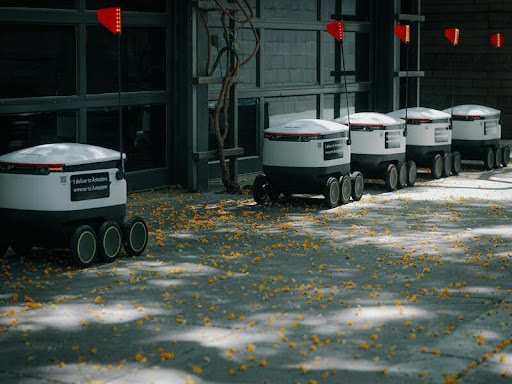
“Street-side pit stop for the future of delivery.”
AI is like the brain behind self-driving cars. It processes data, makes decisions, and learns from experience, all so vehicles can navigate roads without a human at the wheel. Think of it as a digital co-pilot that’s always alert and never gets distracted.
How big is the autonomous vehicle market in the U.S.?
Answer: It’s growing fast. In 2025, the U.S. autonomous car market is worth around .8 billion, and it’s on track to grow at a 20.5% CAGR to reach roughly billion by 2030 (Mordor Intelligence). Globally, the autonomous vehicle industry is even larger; estimates suggest it could be worth 3.8 billion in 2025 and soar to .2 trillion by 2033 (Precedence Research, Fortune Business Insights).
So yeah, it’s not sci-fi, it’s real, and it’s already a massive, booming field.
How does AI let smart cars “see”?
AI powers perception by crunching data from sensors like cameras, lidar, and radar. It helps vehicles detect, then classify, objects on the road: cars, cyclists, pedestrians, stop signs, you name it. And it handles tricky environments too, like crowded city streets or poor weather.
Here’s the kicker: AI doesn’t just “see”, it understands. It recognizes patterns, predicts movements, and adapts on the fly. That’s what turns automation into autonomy.
How do autonomous vehicles decide where to go?
Path planning, route optimization, and behavior prediction, all wrapped into one AI system. Basically, the vehicle analyzes traffic conditions, anticipates what other drivers or pedestrians might do, and picks the safest, smoothest path.
It’s not just about avoiding collisions, it’s about balancing safety, comfort, and efficiency. So, your ride feels natural, not robotic.
Is AI making roads safer?
Yes, and the numbers back it up. Human error causes around 94% of car crashes in the U.S. (Mordor Intelligence, css.umich.edu). A study by Waymo, covering 56.7 million miles across multiple cities, showed huge reductions in injuries: 92% fewer pedestrian injuries, 82% fewer cyclist/motorcyclist injuries, and 96% fewer intersection crashes compared to human-driven vehicles (The Verge).
Looking across the U.S., researchers estimate AI adoption at scale could save up to 34,000 lives per year, based on extrapolating current crash trends (Vox). That’s a life-changing impact.
What about robotaxis in the U.S? What’s the latest?
Waymo is leading the charge, offering 250,000 paid rides per week across cities like Phoenix, SF, LA, Miami, Atlanta, and Austin (Wikipedia).
Uber reports that Waymo vehicles now complete more daily trips per vehicle than 99% of its human drivers (Business Insider).
Across the broader landscape, over 1,500 robotaxis are currently operating in five U.S. cities. That number could balloon to 35,000 by 2030, potentially capturing 8% of the U.S. ridesharing market (Goldman Sachs).
Meanwhile, Tesla’s robotaxi pilot in Austin is expanding, now covering about 80 square miles, but it’s still invitation-only and human-supervised (Statesman).
Why are companies like Uber and Lyft betting on AVs?
It’s about cost, scale, and future potential. Uber plans to deploy 20,000 autonomous taxis over six years, using electric Lucid SUVs with Nuro’s tech (Statesman). Lyft, holding 30% of the U.S. ride-share market, is testing AVs in Atlanta and planning further expansion into Dallas by 2026 (The Wall Street Journal).
They see driverless fleets not as replacements overnight, but as long-term partners in a hybrid world, blending human drivers with AVs.
What’s Tesla doing on the AI chip front?
Tesla recently shifted its AI hardware strategy. The company shut down its Dojo supercomputer project and is now focusing on in-house AI5 and AI6 inference chips. These are designed for real-time decisions and are being developed under a .5 billion deal with Samsung, with help from Nvidia and AMD (Reuters, Investors, Statesman).
In short: Tesla is streamlining its AI compute to power future robotaxi hardware more efficiently.
What’s the role of AI in connected tech like V2X?
AI doesn’t just act solo; it syncs vehicles with infrastructure, other vehicles, and even pedestrians. This Vehicle-to-Everything (V2X) communication helps with traffic flow, congestion, and predictive risk handling. While specific U.S. data is still emerging, it’s clear AI-powered connectivity is becoming a cornerstone.
How about ethics, regulation, and U.S. concerns?
AI must meet U.S. safety standards, data privacy, and cybersecurity norms. Ethical decisions, like how an AV prioritizes safety, are hot topics. Regulations vary by state and city, and they’re still catching up to the speed of innovation.
Even so, the benefits, better safety, access for elderly and disabled riders, and less congestion, make a compelling case for careful but steady integration.
FAQ (for schema)
Q: How does AI improve safety in autonomous vehicles? A: AI reduces human-error crashes by using sensors and data-driven decision-making. Studies show large reductions in injury rates and potentially tens of thousands of lives saved annually.
Q: Are robotaxis operating in the U.S.?
A: Yes. Waymo leads with services across multiple cities and hundreds of thousands of rides weekly. Tesla and other companies like Uber and Lyft are testing or planning deployments, too.
Q: What’s the U.S. AV market size? A: Approximately .8 billion in 2025, expected to grow to billion by 2030 (20.5% CAGR).
Q: Why is the AI chip strategy important for AV companies? A: Efficient, powerful inference chips enable real-time decision-making in AVs. Tesla’s shift to AI5/AI6 chips is a prime example of this trend.
Wrapping it up
AI is central to the future of self-driving in the U.S.; it’s the “brain,” the decision-maker, and the safety monitor all in one. The tech is advancing fast, backed by real stats, millions of miles driven, and heavyweight investments. And while the shift won’t happen overnight, think hybrid models and cautious rollouts, it’s well underway.
About the Author