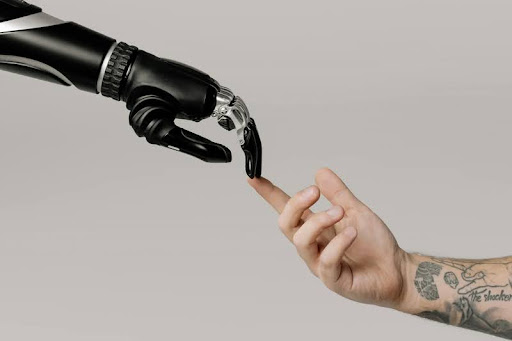
Human and machine in sync—where connection meets technology.
Have you ever questioned why your Spotify playlists seem to capture your mood more accurately than you can? Or how does an e-commerce site recommend precisely the item you had in mind? This isn’t sorcery, it’s the effect of AI-driven personalized marketing.
In today’s landscape, brands no longer scatter ads into the digital expanse, hoping for success. They are becoming more strategic. They leverage artificial intelligence (AI) to customize your experience, transforming marketing into a personal dialogue.
Let’s explore how AI is reshaping personalized marketing and why this transition is increasingly significant in our interconnected world.
What is tailored marketing, and why is it important?
Tailored marketing refers to customizing content, offers, and communications for individual users based on their behaviors, preferences, and data.
Rather than using generic advertisements, it emphasizes relevance. Picture receiving emails with your name, suggestions based on previous purchases, or landing pages that change according to your location.
Why is this important? Individuals are overwhelmed by content every day. Tailored marketing penetrates this clutter by addressing a user’s interests directly, resulting in higher engagement, loyalty, and, let’s face it, increased sales.
How does AI assist marketers in personalizing content?
AI enhances tailored marketing by making it faster, smarter, and more scalable.
Here’s how it works:
It processes vast amounts of data in real-time, something beyond human capability at scale.
It identifies behavioral patterns, such as what users click, search for, buy, or disregard.
It forecasts outcomes, enabling marketers to deliver the right message at the optimal moment.
The outcome? More pertinent interactions without the uncertainty.
What are the primary applications of AI in personalized marketing?
AI’s involvement in marketing is rapidly expanding, influencing nearly every aspect of the process. Let’s examine it:
1. Enhanced audience segmentation
Say goodbye to static customer categories. AI applies dynamic clustering based on real-time behaviors, what individuals view, the duration of their page visits, or the devices they utilize.
This ensures your message targets the right audience at the ideal moment, maintaining the balance between overly broad and overly niche.
2. Mapping the customer journey
AI monitors a customer’s trajectory from the initial click to the ultimate purchase (and beyond). It can anticipate their subsequent actions, allowing marketers to smoothly guide them through the sales funnel.
It’s like having GPS for your customer’s decision-making process.
3. Personalized content delivery
Ever notice how the content on Netflix or Amazon seems tailored just for you? AI makes that possible.
Whether it’s custom email content, homepage recommendations, or personalized landing pages, AI decides what to show each user based on their unique profile.
4. Chatbots that help
Not those clunky old-school bots, but intelligent chat systems that learn from conversations and can respond based on user intent.
They can recommend products, solve problems, or even upsell, without needing a human rep on standby.
5. Predictive recommendations
AI can predict what a customer might need before they even search for it. Think of it as marketing that reads your digital body language.
If someone frequently browses outdoor gear, AI might suggest hiking boots before they even ask.
What are the benefits of using AI in personalized marketing?
Let’s be real, personalization without AI is tough. You’d need a small army of analysts. Here’s why AI gives marketers an edge:
- Higher engagement: Personalized emails have 29% higher open rates and 41% higher click-through rates, according to recent industry data.
- More conversions: When customers feel understood, they’re more likely to act. AI helps match offers to intent.
- Better use of data: Marketers collect tons of data. AI turns it into insights, not just noise.
- Scalability: AI handles personalization for thousands, even millions, of users at once. No manual effort needed.
In short, AI brings personalization to life at a humanly impossible level.
What challenges come with AI-driven personalization?
Okay, so AI sounds amazing, but it’s not all smooth sailing. There are a few bumps in the road to watch for:
1. Privacy and data concerns
People care about their data, especially in the U.S., where privacy regulations are heating up. AI needs data to work, but collecting and using it responsibly is a must. Transparency and consent aren’t just nice, they’re necessary.
2. Automation vs. authenticity
There’s a fine line between personalized and creepy. If AI goes too far, it might feel invasive rather than helpful. Also, too much automation can strip out the human touch.
Marketers need to balance efficiency with empathy.
3. Bias and fairness
AI learns from data, and if that data is biased, the results will be too. That’s a real risk when it comes to targeting or exclusion.
Making sure AI tools are trained on fair, representative data sets is crucial.
4. Tech complexity
Not every business has the tools (or budget) to use AI effectively. And even with access, it takes time to learn how to integrate AI into existing workflows without breaking stuff.
What’s the future of personalized marketing with AI?
It’s only getting more advanced. AI won’t just suggest what to watch or buy, it’ll start creating content, adjusting tone and timing on the fly, and integrating deeply into every touchpoint.
Here’s what’s ahead:
- Hyper-personalization: Going beyond names and product picks to personalized experiences, customized videos, interactive content, and dynamic pricing.
- Omnichannel AI: Seamless personalization across web, mobile, social, email, and in-store, AI keeps the experience consistent no matter where you are.
- Voice and visual AI: As tools like voice assistants and visual search grow, AI will play a key role in delivering personalized results based on voice commands or images.
- Real-time adjustments: AI will increasingly fine-tune campaigns as they run, adapting in real-time to maximize impact.
So, what’s the takeaway? If you’re in marketing, ignoring AI isn’t just risky, it’s a missed opportunity.
How can businesses start using AI in their marketing strategy?
You don’t need to go full sci-fi right away. Start small, with tools you probably already have:
- Use your CRM’s AI features to segment audiences
- Set up behavior-triggered emails
- Try AI-powered A/B testing tools
- Add a smart chatbot to your website
- Explore platforms that offer predictive analytics
The best way to start? Identify one area where personalization is lacking, and test how AI can help.
Quick Stats That Show AI’s Marketing Impact
Want some numbers to back it all up? Here’s what the latest data tells us:
- 91% of consumers are more likely to shop with brands that offer relevant recommendations.
- 80% of consumers say they’re more likely to make a purchase when brands offer personalized experiences.
- Companies using AI for personalization see a 15% to 20% increase in marketing ROI, according to McKinsey.
That’s not a trend, it’s a shift in how marketing works.
Final Thoughts: Embrace the Shift, But Stay Human
AI is changing the way marketers connect with people. It’s smarter, faster, and more targeted. But here’s the thing: it’s not a replacement for human creativity, empathy, or common sense.
The best marketers will use AI to enhance their strategy, not replace it.
So, whether you’re running a small business or leading a marketing team, it’s time to ask yourself:
What part of my customer experience could feel more personal? AI might just be the key to unlocking it.
FAQ: AI and Personalized Marketing (for Schema Markup)
What is AI in personalized marketing? AI in personalized marketing uses machine learning and data analysis to deliver customized content, offers, and experiences to individual users.
How does AI improve customer experience? AI tailors marketing messages to user preferences and behaviors, making interactions more relevant and reducing friction in the customer journey.
Is AI marketing expensive for small businesses? Not necessarily. Many platforms (like email tools and CRMs) include built-in AI features that small businesses can start using without a huge budget.
Does AI personalization violate user privacy? It can if not used responsibly. Brands should follow privacy laws, be transparent, and give users control over their data.
What’s the future of AI in marketing? Expect more real-time personalization, better predictive insights, and integration across multiple channels, from websites to voice assistants.
Ready to Take the First Step?
Whether you’re just dipping your toes into AI or already knee-deep in data, there’s always room to refine your personalization strategy.
Curious how AI could fit into your current setup? Start small. Test. Learn. Repeat.
And if you found this article helpful, share it with your team or drop a comment. We’d love to hear how you’re using AI to connect with your audience!
About the Author




