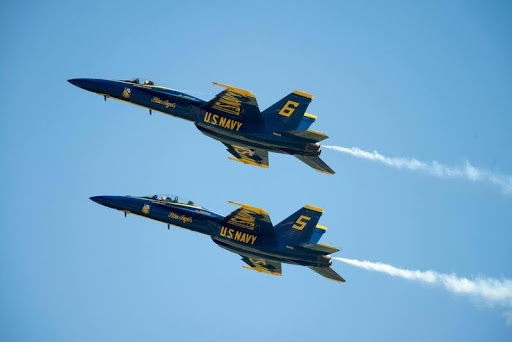
Precision in motion—U.S. military jets showcasing speed, coordination, and advanced aerial technology.
In simple terms, AI is making the U.S. military sharper, faster, and smarter. From crunching massive amounts of imagery to coordinating whole fleets of flying drones, AI is quietly becoming the sidekick everyone needs. And yep, we’re talking real numbers: the Department of Defense’s spending on AI-related contracts grew from about 0 million before August 2022 to 7 million by August 2023, with total potential spending ballooning to .3 billion. And that’s just a start. (TIME)
How fast is the military AI market growing?
Imagine a pie representing the global military-AI market, by 2024 it was worth about .4 billion, and the U.S. alone accounted for .7 billion. The sector is expected to grow at a whopping 13–13.4 % CAGR over the next decade. (Global Market Insights Inc., Grand View Research) North America made up nearly a third of that market in 2024. (Grand View Research)
What’s AI doing when it comes to target decisions?
With tools like the NGA Maven (formerly Project Maven), AI helps sift through satellite and drone imagery to identify potential targets, fast. The system now enables over 25,000 military and civilian users globally, and can generate 1,000 accurate decisions per hour. (The Washington Post, Wikipedia) That’s a big leap in speed and clarity.
Why are drone swarms such a big deal?
Swarm intelligence? It’s wild. Picture dozens (even hundreds) of drones talking to one another, spreading out, adapting, and working toward a shared goal. These coordinated flocks are far more capable than lone drones. In one case, Shield AI’s V-BAT drones use AI to coordinate in GPS-denied environments and have even been deployed successfully in tough theaters like maritime zones. (Wikipedia)
What about pilotless fighter jets? Are those real?
Yes, and soon you’ll see them in action. The Air Force is rolling out over 1,000 autonomous “loyal wingmen” drones that can fly beside piloted aircraft. They’re cheaper too, around a million per drone versus an F-35. (AP News) Plus, the Collaborative Combat Aircraft (CCA) program is backed by nearly $8.9 billion, aiming to mix manned and unmanned airpower. (Wikipedia)
Is the military syncing everything together?
Enter JADC2, Joint All-Domain Command and Control. It’s a fitting name. The goal? Link up sensors across all military branches (Air Force, Space Force, Army, Navy, Marines) into one AI-powered network. One big tactical brain. Funding is under contention, but it’s close to deployment. (Wikipedia)
Is generative AI part of the mix yet?
Yep. It’s being eyed for planning, policy, and even influence campaigns. A July 2025 RAND report examines how generative AI could streamline communications and strategy within DoD. Imagine smarter briefing documents, scenario packages, and operational templates, all generated on demand. (RAND Corporation)
How is the U.S. investing in AI, and who’s doing the building?
Silicon Valley is leaning in. Companies like Palantir just landed a billion-dollar Army contract that consolidates 75 separate deals. (Axios) Laws coming from DC are also pouring cash into tech firms like Palantir and Anduril; a recent spending bill included some $300 billion for modernizing defense tech. (Financial Times)
Plus, places like Huntsville, Alabama, are becoming hot spots for AI-driven fire-control systems. The “Golden Dome” missile defense program could attract up to 5 billion by 2028, boosting drone and AI infrastructure. (Axios)
What about ethics? Are “killer robots” coming?
Nobody wants that. Smart folks and venture capitalists alike are insisting on ethical guardrails, even while rolling out AI for defense. “Nobody wants autonomous ‘killer robots’,” and teams are pushing for transparency, data integrity, and human oversight. (Business Insider) Nuclear experts are also clear: AI might support decision-making, but humans must stay in control. (WIRED) In academia, frameworks for trustworthiness and ethics, like FATE (Fairness, Transparency, Accountability, Ethics), are actively being developed. (arXiv)
Seamless Transition and Dynamic Flow
You see how it all ties together? AI is making better sense of data, coordinating across platforms, speeding decisions, and still keeping humans in the loop. And we’re talking ground-to-air, planning cells to drone swarms to massive data sync, all backed by real contracts, real deployments, and real budgets.
FAQ (for schema, quick answers)
Q: What is JADC2? A unified AI-powered network linking sensors and systems across all U.S. military branches for seamless data sharing and faster decision-making. (Wikipedia)
Q: How fast can AI in the military process targeting decisions? NGA Maven can enable up to 1,000 accurate targeting decisions per hour, 25,000 users tap into it. (The Washington Post, Wikipedia)
Q: How much is the U.S. investing in military AI? As of mid-2023, DoD contracting jumped from 0 million to 7 million, with total potential reaching .3 billion. (TIME)
Q: Are autonomous weapons being used ethically? Efforts are in place to ensure human oversight, transparency, and to avoid autonomous “killer robots.” Frameworks like FATE are guiding responsible use. (Business Insider, arXiv)
Q: Are autonomous weapons being used ethically? Efforts are in place to ensure human oversight, transparency, and to avoid autonomous “killer robots.” Frameworks like FATE are guiding responsible use .(Business Insider, arXiv)
About the Author