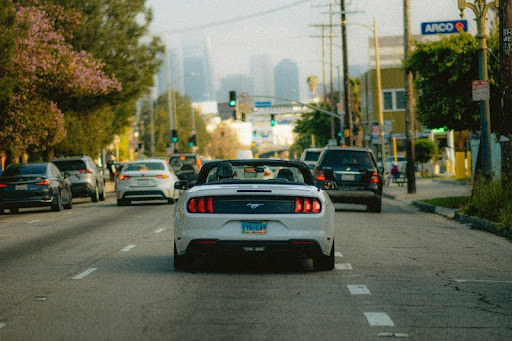
A sleek convertible navigates the city on its own—no driver required.
Self-driving cars used to feel like science fiction. Now, they’re a real technology being tested on roads across the U.S. and around the world. But here’s the question that gets most people curious: how exactly do these vehicles “think” for themselves?
The short answer, algorithms. These step-by-step instructions are what allow a car to “see,” process information, make decisions, and move safely without human input. In this article, we’ll unpack the main types of algorithms powering autonomous vehicles, explain why they matter, and explore where this technology is headed.
So, buckle up, let’s dive into the fascinating world of self-driving car algorithms.
Why Are Algorithms So Important in Self-Driving Cars?
Think of an algorithm as a recipe. If you follow the steps correctly, you end up with the dish you want. In the case of self-driving cars, the “dish” is safe, smooth driving.
These vehicles rely on algorithms for three big tasks:
- Perception – understanding the world around them.
- Planning – deciding what to do next.
- Control – carrying out those decisions in real time.
Without algorithms, self-driving cars would just sit there, unable to interpret their environment.
What Algorithms Are Used for Perception?
Perception is basically how a car sees the road. But instead of eyes, it uses cameras, radar, LiDAR, and GPS. Algorithms process this massive stream of data to recognize lanes, traffic lights, road signs, other cars, and even pedestrians.
Computer Vision Algorithms
Computer vision lets cars recognize objects in images and video feeds. Algorithms detect road lanes, traffic signs, lights, and obstacles. The goal is to process images the way a human driver’s brain does, but with machine-level accuracy.
Sensor Fusion Algorithms
Relying on just one sensor isn’t enough. That’s where sensor fusion comes in. These algorithms combine data from cameras, radar, and LiDAR to create a more reliable picture of the environment. If one sensor misses something, another fills in the gap.
Localization Algorithms
It’s not enough to “see”, the car also needs to know where it is. Localization algorithms compare sensor data with digital maps, helping the car position itself on the road with incredible accuracy, often within a few centimeters.
How Do Prediction Algorithms Work?
Imagine you’re at a four-way stop.
You’re not just looking at where cars are, you’re guessing what they’ll do next. Will that car turn left? Is the pedestrian about to cross?
Self-driving cars rely on prediction algorithms for this exact purpose. They model the behavior of vehicles, cyclists, and pedestrians, estimating where they’re likely to be in the next few seconds. This allows the car to make proactive, safe decisions instead of simply reacting at the last second.
What Are Planning Algorithms in Self-Driving Cars?
If perception answers “what’s out there?” and prediction answers “what might happen?” then planning tackles the big one: “what should I do?”
Path Planning
Path planning algorithms figure out the best route from Point A to Point B, accounting for traffic rules, road conditions, and safety.
Behavior Planning
These algorithms decide how the car behaves in specific situations, like when to change lanes, yield, or stop at an intersection.
Decision-Making Algorithms
Decision-making blends path and behavior planning. It weighs multiple options and chooses the one that balances efficiency with safety.
How Do Control Algorithms Keep the Car Moving Safely?
Once the car has a plan, control algorithms make it happen. They handle steering, braking, and acceleration, essentially acting as the car’s reflexes.
The aim is smooth, natural driving. Too jerky, and passengers won’t trust the system. Too slow to react, and safety is at risk. Control algorithms constantly adjust to ensure a stable and comfortable ride.
What Role Does Machine Learning Play in Self-Driving Cars?
This is where things get interesting. Traditional algorithms are great at following rules, but self-driving cars operate in unpredictable environments. Enter machine learning and neural networks.
- Supervised learning trains the car with labeled data, like showing it thousands of images of stop signs until it recognizes them on its own.
- Unsupervised learning helps find patterns in data without labels, useful for clustering driving scenarios.
- Reinforcement learning is like trial and error.
The car tests actions, gets feedback, and learns what works best.
Neural networks, especially deep learning, power advanced perception and decision-making. They’re modeled after the human brain, capable of handling complex inputs such as image recognition and real-time decision-making.
What Are the Challenges of Self-Driving Car Algorithms?
Sounds impressive, right? But these systems aren’t perfect.
- Unpredictable conditions: Weather like heavy rain or snow can confuse sensors.
- Computation limits: Processing real-time data from multiple sensors requires massive computing power.
- Safety trade-offs: Cars must strike a balance between caution and efficiency. Being overly cautious can cause delays, while being too aggressive increases risk.
These challenges highlight why self-driving cars are still under development and not yet widespread on American roads.
What’s the Future of Algorithms in Autonomous Driving?
Algorithms are evolving rapidly. With advancements in AI and deep learning, cars are getting better at handling complexity. Another growing focus is explainable AI, making algorithms more transparent so humans can understand why a car made a certain decision.
As regulations and technology advance, algorithms will continue to move closer to making fully autonomous driving safe and practical.
FAQ: Algorithms in Self-Driving Cars
Q1: What are the main algorithms used in self-driving cars? They include computer vision, sensor fusion, localization, prediction, planning, control, and machine learning algorithms.
Q2: How do self-driving cars recognize obstacles? They use computer vision and sensor fusion to process data from cameras, radar, and LiDAR to detect and classify objects.
Q3: Do self-driving cars use AI? Yes, artificial intelligence and machine learning play a central role, especially in perception and decision-making tasks.
Q4: Why are algorithms important for autonomous vehicles? Without algorithms, self-driving cars couldn’t interpret sensor data, plan safe routes, or control movement effectively.
Q5: What challenges do algorithms face in self-driving cars? They struggle with unpredictable weather, high computational demands, and balancing safety with efficiency.
Final Thoughts
Self-driving cars may feel futuristic, but the truth is, algorithms are already driving much of their progress. From perception to control, each layer of technology works together to help vehicles navigate roads safely and intelligently.
The road to fully autonomous cars isn’t short, but it’s paved with smarter, faster, and more reliable algorithms.
About the Author




