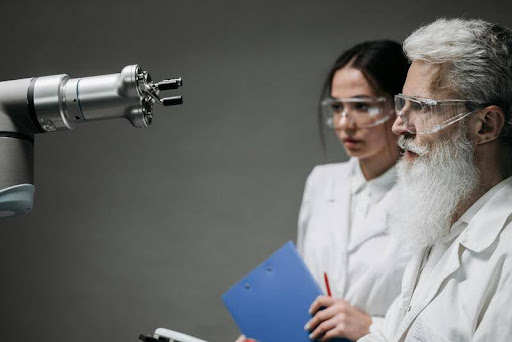
Humans and machines face to face—navigating the future of work, one step at a time.
Artificial Intelligence (AI) is no longer science fiction. It’s real, it’s growing fast, and it’s changing how we live and work. So, the big question a lot of Americans are asking right now is this: Will AI replace human jobs? Let’s talk about it, honestly, clearly, and without hype.
What Can AI Do in the Workplace?
AI is great at handling tasks that follow clear rules or patterns. Think of it like a super-efficient assistant that doesn’t get tired, doesn’t take breaks, and doesn’t need health insurance. It’s especially good at:
- Sorting data
- Automating emails and scheduling
- Analyzing trends
- Running chatbots
- Helping with basic decision-making
This kind of automation has been sneaking into our work lives for a while. But with advances in machine learning and natural language processing, it’s speeding up, and that’s where the concern kicks in.
Which Jobs Are Most Likely to Be Replaced by AI?
Let’s be real: some jobs are more at risk than others.
Jobs that involve repetitive tasks, like data entry, basic customer service, or routine inspections, are on the front lines of automation. Roles like:
- Cashiers
- Telemarketers
- Warehouse workers
- Basic accounting clerks
- Entry-level administrative assistants
These jobs often involve rule-based tasks that AI can replicate, often more efficiently and at a lower cost.
According to a 2023 report from McKinsey, up to 30% of work hours in the U.S. could be automated by 2030. That doesn’t mean jobs disappear overnight, but it does mean the nature of those jobs could change, or shrink.
What Jobs Are Least Likely to Be Replaced by AI?
Now for some good news: not all jobs are on the chopping block.
AI struggles with things like empathy, creativity, and complex human judgment. Jobs that rely heavily on these traits are safer (at least for now).
- Teachers
- Healthcare workers (like nurses and therapists)
- Skilled trades (like electricians and plumbers)
- Creative professionals (writers, designers, marketers)
- Leadership and strategy roles
Sure, AI might help with lesson planning or diagnosing medical conditions, but the human element, the part that requires trust, nuance, and emotional intelligence, is tough to automate.
How Is AI Changing the U.S. Workforce?
The U.S. job market is already feeling the effects.
There is a noticeable change in the types of skills that employers are seeking. An increasing number of positions now require technological fluency, adaptability, and problem-solving abilities.
In essence, it’s not only about what tasks you perform, but also about how you execute them that holds significance. Individuals in manual or administrative positions may need to undergo retraining or develop new skills to remain competitive.
This change isn’t uniformly experienced by everyone. Urban centers with a higher concentration of tech jobs may transition more smoothly, whereas rural areas or those heavily dependent on manufacturing might confront greater challenges.
Is AI Altering the Essence of Work Itself?
Yes, and substantially.
The distinction between “human” tasks and “machine” tasks is becoming less clear. Numerous roles now consist of a combination of both. For instance, a marketer might utilize AI to interpret data but will still determine the final tone or message of a campaign.
This mixed-method approach is gaining traction. Rather than wholly replacing jobs, AI tends to transform them. Consider it a shift from executing tasks to overseeing the systems that carry them out.
What’s the optimal way to remain relevant? Maintain flexibility. Engage in continuous learning. Cultivate soft skills (such as effective communication and teamwork) and combine them with technical expertise. That combination is potent.
What Role Should Policy Have in the Advancement of AI?
AI is progressing rapidly. However, U.S. policy is lagging behind.
There is an increasing necessity for regulations concerning:
Fair labor standards
Privacy and data security
Support for retraining and skill enhancement
Ethical implementation of AI in hiring and decision-making processes
Collaborations between the public and private sectors may be essential for assisting workers through this transition. Enhanced funding for community colleges, coding bootcamps, and ongoing educational programs could significantly impact the situation.
Without robust policy measures, the disparity between high-skilled and low-skilled laborers may widen, which would lead to a rise in economic inequality. And that is something everyone wants to avoid.
So, Will AI Truly Usurp Human Jobs?
Here’s the situation: AI will take over specific tasks, not entire jobs.
Certain positions will vanish. Others will transform. And entirely new roles will emerge that we have yet to conceive. This pattern has always accompanied technological advances.
The real challenge for employees is not merely to evade automation; it’s about learning to collaborate with it. Humans contribute intuition, empathy, and creativity, while machines offer speed, accuracy, and recall. When combined, they form a formidable alliance.
Thus, instead of questioning, “Will AI take my job?” a more pertinent inquiry might be: “How can I equip myself for the future of work?”
What Actions Can You Take Now?
If you feel uncertain about your career’s position in this evolving landscape, know that you’re not alone.
But you’re not powerless, either. Here are a few simple steps to start preparing:
- Upskill regularly – Learn digital tools related to your field.
- Focus on soft skills – Empathy, critical thinking, and leadership.
- Stay curious – Follow trends, attend webinars, and read.
- Build a hybrid mindset – Think about how to partner with AI, not compete with it.
Change is coming either way. Better to ride the wave than get knocked over by it.
FAQ: Will AI Replace Jobs in the U.S.?
Q: What jobs are most at risk of being replaced by AI? A: Repetitive, rule-based jobs like data entry, telemarketing, and cashier roles.
Q: What kinds of jobs are safest from AI replacement? A: Roles needing empathy, creativity, or complex judgment, like nursing or teaching.
Q: How is AI affecting the U.S. job market? A: It’s shifting demand toward tech-savvy, adaptable workers and reshaping traditional job roles.
Q: Can people retrain for AI-proof jobs? A: Yes. Upskilling, tech education, and soft skill development are key.
Q: Will AI cause mass unemployment in the U.S.? A: Not likely. It will change jobs more than eliminate them outright.
Want to stay ahead of the curve? Keep learning, stay flexible, and don’t be afraid of change. After all, the future of work isn’t about man vs. machine.
About the Author




